Building a Custom WordPress Theme for a Luxury Golf Travel Brand — Global Golf Shuttle
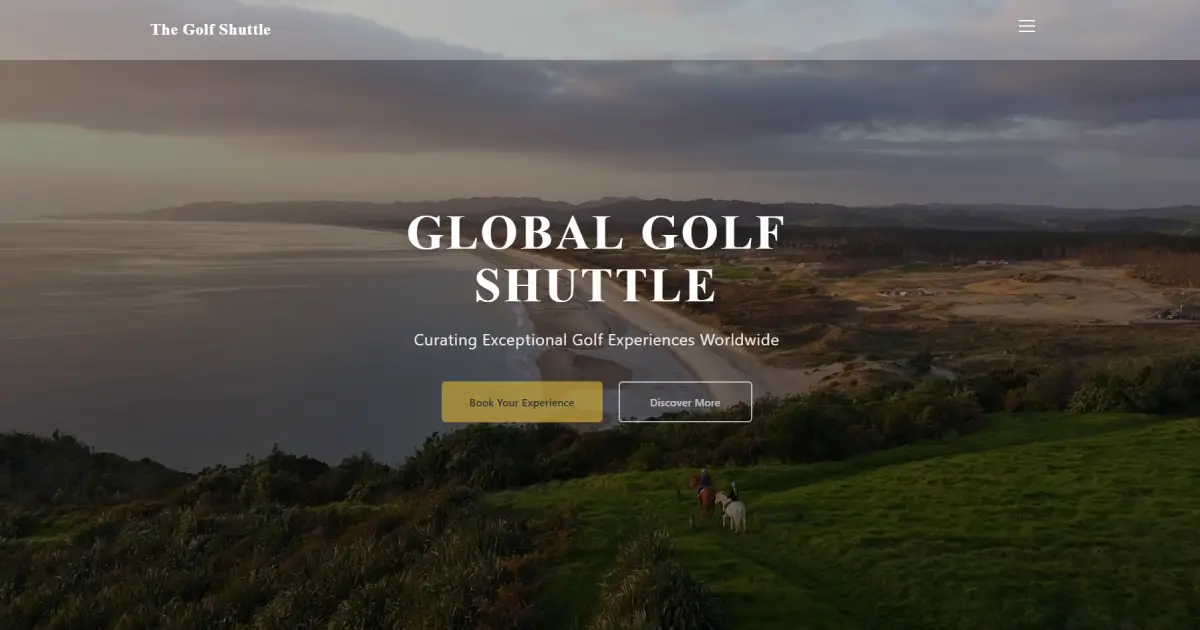
I built a fully custom WordPress theme for Global Golf Shuttle — a luxury golf travel company operating since 1997. Here's the full breakdown of the architecture decisions, design approach, and performance strategy behind a site that needed to look and perform at the same level as the experiences they sell.
When Global Golf Shuttle reached out, the brief was clear: the website needed to feel like the brand. Not a template dressed up with a logo swap — an actual, purpose-built digital presence for a company that's been arranging private jet charters, exclusive tee times, and luxury ground transfers for discerning golfers since 1997.
That kind of client has zero tolerance for slow load times, generic layouts, or anything that feels off-the-shelf. So I built them a fully custom WordPress theme from scratch. Here's exactly how I approached it.
Understanding the Business First
Before writing a single line of code, I needed to understand what Global Golf Shuttle actually does — and more importantly, what their site needs to do for them.
They operate across five destination markets: New York City, New Zealand, Spain, Anguilla, and the Philippines. Their service stack includes private jet charters through a Jetluxe partnership, exclusive tee time access at sold-out prestige courses, luxury accommodations, and personal concierge coordination. The primary conversion action is a reservation inquiry — so every page, every section, every CTA had to funnel toward that.
This isn't a WooCommerce situation. There's no product catalog. It's a service-driven, high-trust conversion model, which means the site had to earn credibility fast and get out of the way of the inquiry form.
Why a Custom Theme and Not a Page Builder
I'll be direct: page builders — Elementor, Divi, WPBakery — are not built for sites like this. They carry bloated JavaScript, inject inline styles that fight your design system, and create markup that's nearly impossible to maintain cleanly long-term. For a luxury brand, the code quality matters just as much as the visual output.
A custom theme gives me complete control over:
- The DOM structure and semantic HTML
- What scripts and styles actually load and when
- How WordPress's template hierarchy is used intelligently
- The performance baseline from day one
For Global Golf Shuttle, I built on a clean PHP 8.x foundation using WordPress's native template hierarchy — no framework dependencies, no page builder cruft.
Theme Architecture
The theme is structured around a component-based approach inside a traditional WordPress theme hierarchy. Rather than having monolithic page templates, I broke the UI into reusable template parts that get pulled in contextually.
The destination pages are a good example of this. Each destination — New York, New Zealand, Spain, Anguilla, Philippines — shares the same underlying template structure but pulls in destination-specific content through Advanced Custom Fields (ACF). This keeps the design consistent, makes client updates straightforward, and avoids duplicating template logic across five near-identical pages.
The services section follows the same pattern. The architecture for the Private Jet Charters page, the Group Outings page, and the general Services overview all share template parts, with ACF handling the content variation. One template to maintain, five pages covered.
Hero Section — The Video Background Implementation
The homepage hero runs three looping background videos — hosted directly on the site's own CDN rather than embedding from an external source. This was a deliberate choice. Third-party video embeds introduce external requests, consent banner complications, and load timing you can't fully control.
The videos cycle through automatically with a lightweight vanilla JavaScript controller — no jQuery dependency, no library overhead. The JS handles the transition timing, preloads the next video before the current one ends, and falls back gracefully to a static image on connections where video loads too slowly.
Performance-wise, the videos are served in WebM format with MP4 fallback, compressed specifically for web playback without sacrificing the visual quality a luxury brand requires. The hero content — headline, subtext, CTAs — layers over the video with enough contrast to remain readable without obscuring what's behind it.
Navigation and Site Structure
The nav is a custom-built mega menu structure registered through WordPress's native menu system. No plugin. The Destinations and Services items both have multi-level dropdowns with direct links to sub-pages — built with CSS and a minimal JS toggle for mobile, keeping the markup clean and accessible.
Mobile navigation collapses to a hamburger menu that pushes a full-width overlay panel rather than a cramped dropdown. Given the luxury positioning of the brand, the mobile experience needed to feel intentional — not like an afterthought.
The Destinations and Destination Pages
The destinations section on the homepage is a grid of five cards — each with a full-bleed image, destination name, brief descriptor, and a link to the full destination page. Images are served in WebP format, lazy-loaded below the fold using the native loading="lazy" attribute. No lazy-load JavaScript plugin needed.
Each destination detail page follows the same template structure: a full-width hero image, an overview section, highlighted courses, available services at that destination, and a booking CTA. All content is managed through ACF field groups — the client can update destination details, add images, and modify course information without touching any code.
Reservation Flow
The primary conversion point across the site is the reservations page. Rather than dropping a third-party booking widget with its own styles, scripts, and external dependencies, I integrated the inquiry form through a controlled implementation that matches the site's design language completely.
Form submissions are handled server-side with proper validation, sanitization, and email routing. No exposed API keys, no client-side-only validation that breaks on JavaScript errors.
Performance Baseline
The target going in was a Lighthouse performance score above 90 on desktop and as close to that as possible on mobile given the video-heavy homepage.
Key decisions that got us there:
- No jQuery. Everything written in vanilla JS. jQuery alone adds ~30KB to a page that doesn't need it.
- CSS is hand-written. No utility framework like Bootstrap or Tailwind — just a well-organized custom stylesheet that only includes what the site actually uses.
- Scripts are deferred or loaded in the footer where render-blocking isn't a concern.
- WebP images across the board with proper width and height attributes set to prevent layout shift.
- A minimal plugin footprint. ACF for custom fields, a caching plugin, and a security plugin. That's essentially it. Every additional plugin is a maintenance liability and a potential performance hit.
Typography and Visual Design
The design language leans into what I'd call restrained luxury — clean, generous white space, a serif-accented type system for headlines, and a dark/neutral palette with gold accents that reads as premium without being overdone.
Fonts are loaded through the Google Fonts API with font-display: swap to prevent invisible text during load. Only the weights and styles actually used on the site are requested — not the full font family stack.
Custom Post Types and Content Management
Beyond the static page templates, the theme includes custom post types for Testimonials and Blog posts, both registered natively in PHP rather than through a plugin. This keeps the admin clean and gives the client straightforward content management without any plugin-specific interfaces to navigate.
The testimonials post type feeds into a dedicated testimonials page as well as a homepage pull quote section — all rendering dynamically from whatever testimonials are published in the backend.
Security Considerations
The custom theme follows WordPress security best practices out of the box: output escaping on all dynamic content, nonce verification on all form processing, no direct file access where it shouldn't exist, and a hardened wp-config setup. Combined with a solid hosting environment and the caching layer, the attack surface is about as minimal as a WordPress site gets.
What the End Result Looks Like
Global Golf Shuttle now has a site that actually reflects the caliber of what they offer. The video hero landing page loads clean. The destination pages give potential clients the information they need to pull the trigger on a booking inquiry. The mobile experience is just as polished as the desktop version. And the client has a manageable backend that doesn't require a developer every time they want to update a destination detail.
That's the standard I hold custom WordPress development to: the front end performs and converts, the back end is maintainable, and nothing is there that doesn't need to be.
If you're running a business that needs a site built at this level — not a template, not a page builder, but actual custom development — get in touch and let's talk about what that looks like for your project.